Friday, May 27, 2022

The Great Migration

             There’s a joke about a guy stranded all alone on a desert island who finally is rescued.  The people who found him noticed there were three grass huts on the island.  When they asked about the huts, the rescued man pointed to one and said, “That’s my house.”  Then he pointed to the next one and said, “That’s where I go to church.”  After a moment of silence, the rescuers asked, “And what about the third hut?”  The man replied, “That’s the church I used to go to.”

            Over the years of my work as a pastor there were a few folks who came looking for a new church.  “Do you preach the prophecy here?”  “What does your church do about homosexuals?”  “What do you believe at this church?”  “Does your church teach that the Bible is the inerrant, literal Word of God?” “Do you believe in the Virgin Birth?”  Some actually began attending whichever church it was at the time. Most did not, however, based on my responses.

            The June issue of The Atlantic contains an article about a “war” within evangelical circles over current political and cultural issues addressed in churches:  How Politics Poisoned the Church.  The article focuses on evangelical congregations, with little mention of mainline Protestant churches, and at times frames the issue as being reflective of “the Church” as a whole.  That makes me cringe a bit, but there are many instances of the same affliction among churches on a broad scale.

            The article highlights how a great number of church-goers move from churches they attend for a long time to different ones when issues like gun control, homosexuality, abortion, race relations, and other hot button issues are dealt with by the pastors and other congregational leaders.

            One of the pastors profiled in the article spends time in worship on what he calls “diatribes,” and gives over a few minutes prior to his sermon to rant about whatever wild hair is creeping up his backside over some of these issues.  His congregation grew when he started making his statements, many of which are based on conspiracy theories, misinformation, and just downright lies.  The writer of the article points out cases where the diatribes of this pastor, as well as hard-boiled stances of others, directly conflict with scripture.  But, tell the people what they want to hear and they will come.

            All of this, of course, picked up a lot of steam in the years since the immediately prior president was elected.  One of the tragedies of this situation is that many people are hunting for a god to worship that is of their own making and that confirms their outlook and biases.

            Mainline denominations have by and large been in decline for decades, and it has to do with similar realities.  Currently, the United Methodist church faces becoming un-united over the issue of the ordination of LGBTQ persons.  There are factions within Presbyterians, Baptists, Disciples and others.  There are more and more “independent” churches that formerly affiliated with a denomination but withdrew over such disagreements.

            Meanwhile, our society experiences an ever-widening gap between the haves and the have-nots; people struggle with food insecurity and low wages in dead-end jobs; hatred of the “other” is blatant and vicious; guns outnumber the population and gun violence is for far too many the preferred means of conflict resolution and venting personal frustrations; political differences of opinion are knock-down drag-out battles in which power and control are sought at all costs; and honesty, integrity, and compassion are considered weaknesses.  It goes on from there.

            Prophets have long been scorned, and even put to death, for wrestling with and trying to tell the truth.  Worship, prayer, meditation, scripture reading, and other spiritual disciples actually have the purpose of trying to understand the heart of God in order that God’s beloved children might come to know and embrace the abundant life God intends for all of humanity, yes, even all of Creation.

            It’s all about God’s love and desire for that love to be shared by everyone rather than appropriating God’s name to serve personal interests and one’s own glorification.

            Someone related an incident that occurred during the height of the Civil Rights era.  A man and his dutiful wife attended a worship service at a different congregation after leaving their usual church over racial justice issues.  Unfortunately for them the sermon that day made application of the gospel to contentions over race and human freedom.  On the way out the door following worship, the man confronted the preacher saying, “We just left a church for preaching that same nonsense you spouted!”

            The preacher looked at him for a moment and said, “Well, I guess you’re running out of places to hide.” 

Monday, May 16, 2022

50 Years!


            Sometime in June of 1972 I graduated from Annandale High School.  The school was “Inside the Beltway,” just a handful of miles from Washington, DC in the Virginia suburbs.  At the time, there were some 2,500 students attending the school, probably 99% Caucasian.  High achievement was expected, practically everyone graduated, and almost as many were college-bound.

            A Baccalaureate Service was held at the National Cathedral in Washington prior to the commencement ceremony, which took place at the Wolf Trap performing arts center.  I have no recollection of the ceremony, the keynote speaker, or anything else related to it, except probably tapping my foot waiting for it to end.  Wolf Trap burned down shortly thereafter, but soon was rebuilt.

            In the half-century since that more-than-likely steamy night, I have had some form of occasional interaction with maybe 8 to 10 of my 600+ classmates.  Anything close to regular contact has been limited to just a couple of them, and there were decades of no contact even with them.   Only in very recent years has the frequency increased.

            There is a class website which I joined out of curiosity. Looking at the “Now” photos of those who dare to post them, I would never recognize almost all of those people if I were to encounter them.  A number of the names are somewhat familiar, but so many of the others have slipped from memory.  I have not attended any class reunions held in the past.  According to the website, the big 50 YEAR REUNION! will be held in October.  They will have to get along without me.

            My experience at the school was pleasant enough, and I had fun with my friends.  I was in the Symphonic Band, played on the baseball team, and was the manager of the school store for a couple of years.  I attended some of the school dances, went to football games when I was in the marching band, and sometimes watched basketball games.  I was close to a couple of teachers and received encouragement from a few others.  Most of my teachers now are deceased, as are some of my classmates, and I only recall returning to the campus to baseball practice a time or two when I was home from college, playing in summer league games that were on the school field, and attending a ceremony to dedicate and name the baseball field in memory of my coach.

            I have nothing against the school or my classmates.  It just isn’t part of my life anymore.  So much has happened since then, I have lived in numerous locations and become acquainted with countless other people.

            Fifty years is a long time. Laying out hundreds of dollars and driving for several hours in order to spend time with strangers does not hold any appeal to me.  For those who have stayed in the area, and/or kept in touch with the school and classmates, and choose to attend, however, I say, “Have fun.” 

Maybe I’ll show up for the 75th reunion…

Thursday, April 21, 2022

Glossophobia


According to a quick, lazy online search, about 75% of people have some level of fear of public speaking.  About 10% are absolutely horrified by the prospect of talking in front of a group.  Some lists of fears rank public speaking neck and neck with death itself.

Interestingly enough, introverted people often can be effective public speakers.  As one article suggests, introverts “spend a lot of time alone thinking, observing and analyzing. An introvert is rarely short of ideas and creativity.  They can often delve deeper into the topic and come up with unique angles that compel the audience to sit up and pay attention. Reading and researching is one of their strengths…”

It has been said, “If you want people to pay attention, say the wrong thing.”  Perhaps that’s one reason many people avoid public speaking:  they don’t want to say the wrong thing.  Indeed, how many times have we listened to a speech or a sermon and all that we truly recall later is a mistake or misstatement that occurred, or something with which we vehemently disagree?

On Easter Sunday, Mary and I heard a preacher refer to “making lemons from lemonade.”  It was reported later that the same mistake was made in all three worship services at the church that day.

One of my esteemed seminary professors told of how once he gave a series of lectures on the Old Testament Creation stories from Genesis, and in referring to the verses describing how God breathed life into the first human beings, the scholar/prophet/teacher intoned, …”in the image of God he created them, feel and mayfeel he created them.”  The Professor had no idea he named new genders until it later was pointed out to him.

My own preaching featured flubs and, no doubt, instances of “taking God’s name in vain.” As a puppy minister in my student days I preached at a church in Indiana.  In an early sermon I was trying to reference a phrase I recently heard, “Hoosier Hospitality.”  In the moment, however, I couldn’t spit it out.  I kept saying, “Hoosier Ha…Hoosier Ha…”  Finally, I stopped and remarked, “All I could think of was Hoosier Hostility.”  Naturally, it got a laugh, and likely was the only part of the sermon anyone remembered.  It’s all I remember about it.

Speaking of seminary days, our weekly chapel service at the school sometimes featured students as the preacher.  Even though glossophobia doesn’t apply to me generally, I made sure I never stood in that pulpit.  Reviews of sermons at the chapel service were savage, especially from other students.  The post-chapel scene was like watching a group of vultures swoop down on fresh roadkill. 

Also, I never could see myself preaching in front of someone like the president of the seminary, whom I held in very high regard.  He truly was a friendly, gentle soul, although very brilliant and accomplished.  (Many years later, at a luncheon, the then-president of the seminary commented that he was “surprised to see that T.J. Liggett isn’t ten feet tall,” having heard of his reputation and work.  I turned to Mary and said, “You mean, he isn’t?”)

T.J. Liggett’s daughter was a member of the National City Christian Church in Washington, D.C., and when I was a pastor there she let me know T.J. would be present for worship one Sunday when I was scheduled to preach.  So, some 20+ years after I avoided preaching in front of him, it finally was going to happen.  At least, I had advance warning.  When I stood in the pulpit, there he was, about four rows from the front, dead center in my field of vision.  I acknowledged his presence, then went about my work.  The sky didn’t fall, the building didn’t collapse, I didn’t faint, nothing bad happened.

Following the service, after shaking the people out, I wandered back into the sanctuary, spotted T.J., and glided over toward him.  He introduced me to the person with whom he was speaking (we had many visitors to the church, it being our denomination’s flagship congregation, located in the bulls-eye center of the nation’s capital), and after a few moments of chit-chat it was evident he wasn’t going to comment on my sermon.  So, I went about my other chores of the day, albeit a bit disappointed.

A few days later, his daughter said, “Did Dad tell you how much he thought of your sermon?”

I replied, nonchalantly, “No, I guess he didn’t.” 

“Well, he thought it was great.”

 “Oh…well, that’s nice.”

Sometime within the following year it happened again, only this time I had no advance warning.  I climbed into the pulpit, looked out at the people, and there he was, again in the same spot as before.

My preaching that day actually elicited applause from the congregation when I finished, and I watched as T.J. slowly approached me after the service, walking with a cane: “Timely.  Insightful. Biblical.” 

I’m not sure if his comment was because I said “the wrong thing,” but I was thrilled, gratified, relieved.   There truly wasn’t any glossophobia that day, but it sure was nice to get that approval from him. 

Friday, March 18, 2022

A Memorable Couple of Days


Kathy, the Advocacy Coordinator of the Southern Tier Office of Social Ministry located in Elmira, New York, and I partnered on a number of public witness activities during the years I was a church pastor there.  One day she called to say there was a Nuclear Disarmament Conference scheduled at Riverside Church in New York City and she wanted to know if I would like to go with her.  She didn’t have to ask twice.

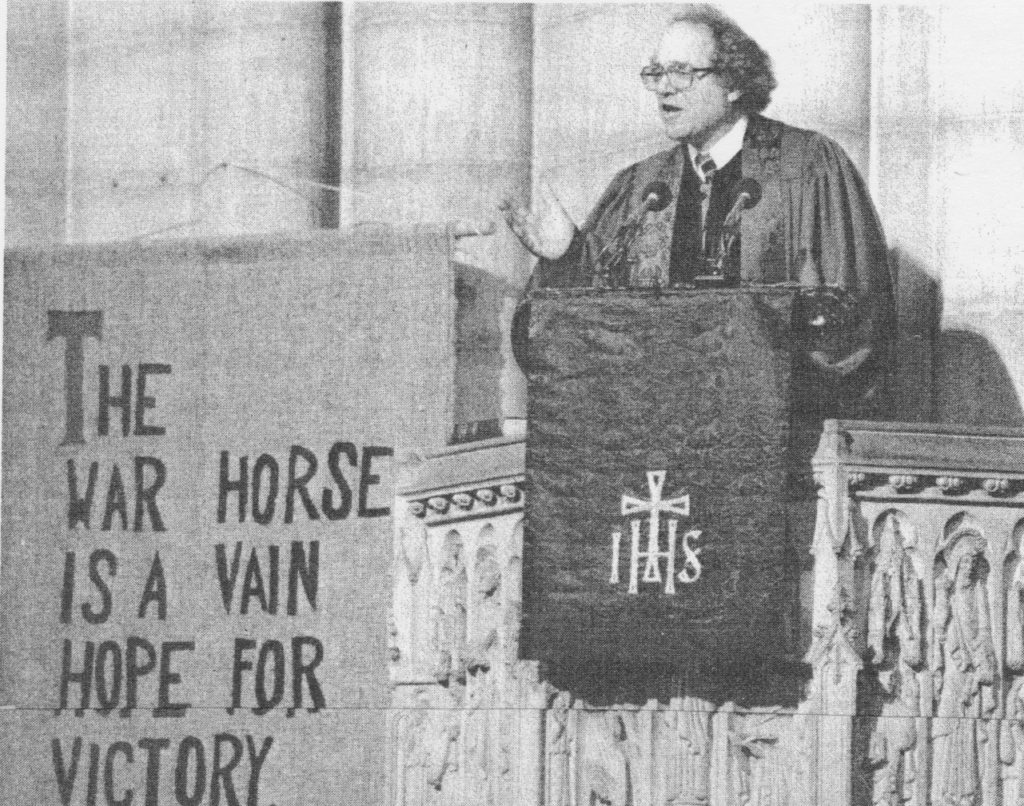
Not long before her call I read Once to Every Man, the memoir of William Sloane Coffin who was the Senior Minister at Riverside.  It was one of those books I could not put down, and I read it in two days.  Subsequent to reading the memoir I got a copy of another Coffin book, Courage to Love, and eagerly soaked up every word of it, as well.  I wasn’t going to pass up a chance to spend two days with someone I found so inspiring.

It was about a four-hour drive from Elmira to New York, and I had arranged to stay overnight at the apartment of a member of Riverside, a Ms. Goossen, who volunteered to make accommodations available for a conference attendee.  Kathy, being from Queens, was booked in with relatives.  We found the street where Ms. Goossen lived, and Kathy dropped me off.

When I checked the address of her building I quickly saw there was no such street number, and as Kathy drove off, I wasn’t sure what to do.  It was dark as I picked up my suitcase and began walking, a bit aimlessly, trying to decide how I might find Ms. Goossen’s apartment.  This was shortly after the Bernard Goetz incident in which Goetz shot one or more young men who aggressively asked him for money on the New York subway.  As I walked along Broadway a man asked me for money, I said no, and he was very apologetic as he backed away.

One thought I had was to try and find Riverside Church and maybe spend the night there, but after walking a few blocks I went into a bar and found a phone booth.  Fortunately, there was a phone book chained to the booth, and even more fortunately, Ms. Goossen was listed.  I saw her address, called to say I was late arriving, and walked back to her street.  The address I originally was given had a couple of the digits transposed, causing the confusion.

The next morning I stood on the street until Kathy arrived to drive us to the church, and we went there without further trouble.

The first workshop I attended featured Rev. Coffin and Professor Seymour Melman of Columbia University speaking about the concept of Economic Conversion, which in essence meant finding a new purpose or product for a munitions factory rather than simply closing it down, thus saving the jobs of the employees.

Following the discussion, I went up to Rev. Coffin, introduced myself, and asked him to inscribe my copy of his book.  He opened the cover, saw where I had put my name, wrote “To” in front of it, then wrote, “God Bless!  Bill C”

Bill C was very visible throughout the whole conference, so I was pleased about that.  At a plenary session in the huge sanctuary Pete Seeger led some singing, and I remember Rev. Coffin introducing others who were present.  When he mentioned a young man there who was facing consequences for refusing to register with Select Service, he said, “We try to raise our children to be people of conscience, so it seems to me we should stand by them in their moments of conscience.” 

There were speakers and workshops on a variety of topics, not all directly related to nuclear disarmament, but equally inspiring nonetheless.  I recall one discussion about a call to boycott Campbell’s Soup because of the poor conditions experienced by produce pickers that supplied the company.  At one point I found a corner in the church and spent some time making notes for my sermon on the following Sunday.  I figured I never would preach at Riverside Church, but I could at least prepare a sermon there.

Following a final workshop I was supposed to meet Kathy in the main lobby outside the sanctuary so we could head for home.  It was a Saturday afternoon, there was a big wedding about to begin in the sanctuary, many people from the conference were milling about, and the elevator opened.  Among the people leaving the elevator there was a pigeon, walking out with everyone as if he were just going about his business in a normal way. None of his fellow passengers seemed to notice or care as he disappeared into the crowd.

Needless to say, after spending time at the conference, being with Rev. Coffin and so many others dedicated to matters of peace and social justice, I was renewed in my commitment to raise the issues that Kathy and I highlighted in our witness together in Elmira. 

Little did I know it would lead me to my further work with the Quakers, and to a few other even closer encounters with William Sloane Coffin, and with his successor Rev. Dr. James Forbes, along the way.


Tuesday, February 15, 2022

Kicking and Punching


One of the gigs we had in the Washington Metropolitan Police Boys Club Band was, I believe, a Boy Scout Jamboree at the D.C. Armory, most likely in 1968.  We probably played several John Phillip Sousa marches, and maybe the National Anthem.  While most of the details have faded from memory after all these years, what I recall for certain is that in the midst of everything else that occurred that evening there was a demonstration of Kung Fu by none other than Bruce Lee.

He wore a white suit as he demonstrated techniques and spoke about martial arts.  At the time, Bruce Lee was featured as the character Kato on the television show, The Green Hornet.  As a 13-year-old, I was more aware of him in that role than I was of his preeminence as a martial arts master.

Bruce Lee’s appearance at the event was sponsored by Jhoon Rhee, a prominent figure in introducing the Korean art of Tae Kwon Do to the United States, and who had several martial arts schools in the Washington, D.C. area.  Master Rhee actually showed up at one of our band rehearsals leading up to the night at the Armory.

At the time, I had little-to-no interest in martial arts and never once imagined that it would become a part of my life.  Like almost everyone else I had no real understanding of what the practice of the arts was about.  Much to my surprise, that all changed a little over twenty years later.  

Around 1990, our two sons, Gabe and Matt, said they wanted to learn Karate.  They, like many other children their ages (roughly 8 and 6 years old at the time) watched the Teenage Mutant Ninja Turtles on television and wanted to be like them.

After some discussion, we signed up the guys in the Fairfax County recreation program of Tae Kwon Do that featured weekly classes for children.  Mary and I sat with the other parents and watched the kids learn basic blocking, kicking, and punching techniques.  The guys enjoyed it, but I still did not think much of it. 

As the kids learned the techniques they occasionally were tested and given belt ranks as they advanced.  Starting as ‘No-belts” they first earned a white belt, then it was on to white stripe belt, and then gold belt.  At that point, the instructor recommended enrolling in an actual martial arts school if the kids intended to continue practicing.    I wasn’t enthralled with the prospect, but the guys were still enthused and wanted to keep going.

So, one evening I took them to the Mountain Kim Martial Arts School in Falls Church to investigate the possibility.  The instructor was Master Park, a solidly built young Korean man whose English, while not great, was better than my non-existent Korean language ability.  The school was one of several Mountain Kim schools, Mountain Kim being a Korean champion Tae Kwon Do master who oversaw the organization.  The Falls Church location was actually the basement with a downstairs entrance in back of a small strip mall shopping area.  There was indoor-outdoor carpet on the floor, mirrors along one wall, a few coat hooks just inside the entrance, a metal desk and chair for Master Park, and a couple of restrooms at the far end of the rectangular cinder block room.

As we discussed enrollment with Master Park, he looked at me and said, “You want to sign-up, too?”  Until that moment it never occurred to me to do so, but it made sense:  I would be there anyway as the guys took classes, and I was not engaged in much, if any, physical activity.  So, I signed up, put on a uniform and joined the class, taking my place in the back with the other “No-belts,” children and youth of various ages.   During the warm-ups, which actually were quite vigorous, Master Park kept an eye on me.  I guess he was worried I might keel over. 

We attended classes three evenings per week, and gradually advanced along the belt rank levels.  Tests were sometimes held at our school and sometimes were held elsewhere when all the Mountain Kim schools came together for tests.  There were tournaments a couple of times a year, and as I attended and observed it was apparent that those of us from the Falls Church school were in better shape and further advanced than most of the students from the other schools.  Master Park worked us hard, and it paid off.  Gabe and Matt won trophies and medals in their age categories at tournaments, as did others from the school.

After a couple of years, the three of us reached the rank of red belt, which was one step below black belt.  At that point, the recommendation was to add Fighting Class to our practice.  While sparring was a part of the training all along the belt-progression track, Fighting Class took it to another level.  So, now we were taking four classes per week, with Fighting Class on Saturday mornings.

I thought Master Park worked us hard before, but this was something else.  We put on full fighting gear even for the warm-ups, which were more intense than regular class warm-ups.  Then it was on to full-contact sparring, usually 8 or 10 two-minute rounds.  It was a workout.  I was about 38 years old.

Suddenly, something happened, and Master Park lost the lease to his school.  It closed and we had to transfer to another school.  We ended up at the McLean school, which was run by Mountain Kim’s brother, Myung Kim, called “Bruce Lee” Kim.  Right away, we saw again that Master Park worked us much harder than students were expected to work in other schools, but several of us from the Falls Church school were together again in McLean, and we took it to a higher level.  Some of the McLean students disappeared after a while.

Speaking of disappearing, we never heard from or saw Master Park again.  It’s still a mystery what happened to him, and none of the Mountain Kim people ever spoke of him or acted like they knew anything when asked.

While we attended weeknight classes at the McLean school, we went to the Vienna school for Fighting Class on Saturdays.  So, that all continued.

Mountain Kim always said that one out of ninety students who began classes at his schools made it to black belt.  The percentages vary among schools and programs, but it seems to be somewhere in that range universally.  I noticed a lot of turnover of students, and it seemed that green belt was a cut-off point for many people.  I’m not sure why, unless people felt they learned enough by that point for the art to be useful to them, but it was pretty common for folks to stop practicing at that level.  The remaining belts were blue, brown and red with the stripe levels in-between.  There was no red stripe, but red was the longest level at which people practiced, in preparation for the black belt test.

After about 26 or 27 months of intense practice, I was ready to test for black belt.  I was 39 years old.  The test lasted some three hours and included demonstrating proficiency at EVERYTHING learned up to that point:  kicking, punching, and blocking techniques; forms, or choreographed sparring patterns for every belt level; one-step sparring, which was a series of reactive moves to attacks, again, for every belt level; board-breaking:  five targets in a combination of punches and kicks for the test; Korean terminology for the techniques and for counting; and, of course, full-contact sparring.

At my test, I was the first one to do the sparring portion, and had to spar with 6 black belts consecutively with only a few seconds between, as one bowed out and the next one bowed in.  Then, I got back in line with the others being tested, and sparred with each of them, about a dozen in all.

Following the test by a couple of weeks was the Black Belt Ceremony where the belts and certificates were presented by Mountain Kim.  In his speech he reminded us of our responsibilities as leaders among the other students, and told us once again, as we were told at the very beginning of our practice as No-belts, to only use Tae Kwon Do techniques in the most extreme circumstances.  It would be better to run away than to fight, he reminded us, and even issued ID cards that we could show to someone who threatened us, letting them know we were black belts.

Part of the responsibilities of black belts was to not only set an example for lower belt students, but also to become instructors.  So, I began teaching classes at the McLean school, holding and grading tests there and at the larger Mountain Kim group tests, and refereeing at tournaments.  I also competed in three tournaments, reaching the final round each time, and winning Grand Champion once, at age 40.

When I finally gave up Tae Kwon Do practice, I was teaching seven classes per week, including one at a local elementary school.  It was, of course, in addition to my real job.

After a few years we moved to Florida, and there Mary and I took up the practice of Tai Chi, which included other Chinese martial arts forms.  After a few years I was teaching classes again, this time just once per week.  All told, I actively practiced martial arts for about 16 years.

So, even though I watched Bruce Lee demonstrate martial arts all those years ago and did not take it seriously, I ended up giving a good portion of my middle years to the practice.  I wish I had begun earlier, and treasure the time spent engaged in a way of life that provided relief from great stress I experienced in my working life, gave me an opportunity to share something meaningful with my family, provided physical as well as mental benefits, introduced me to some nice people and a different culture, and was simply a lot of fun.

Just recently, our grandson Logan, at age 6, earned his gold belt in Tae Kwon Do, making him a third-generation martial artist in our family.


Monday, January 17, 2022

A Haiku

 Since we're snowed in, and our writers' group did not meet this month out of concern for the fast-spreading Omicron variant, today Mary issued a Haiku Challenge to the others in the group.  

Here's my somewhat silly entry:


Outside our window:

A bird with snow on his face.

I took a photo.


Thursday, January 6, 2022

William Penn -- CANCELED


     William Penn, Quaker writer, activist, and founder of Pennsylvania was also a slave owner, although he was an advocate for the humane treatment of slaves (if there were such a thing).  For 55 years his name was used on a Quaker program located on Capitol Hill in Washington, DC – William Penn House.

      In 1966, the Quaker lobbying organization known as the Friends Committee on National Legislation invited the heads of the Quaker United Nations Office in New York to establish William Penn House.  FCNL was overwhelmed by requests for education, training, and lobbying opportunities for those concerned about the Vietnam War and the Civil Rights Movement.

    Bob and Sally Cory moved to Washington, a rowhouse five blocks from the U.S. Capitol was acquired, seminars and training workshops began to occur, and housing was provided for the peace advocates who attended them and who otherwise arrived in Washington to take action on the issues.

     At first, the Corys lived on the premises of WPH, but eventually bought a small house down the street.  William Penn House was established “under the care” of Friends Meeting of Washington, the Quaker congregation in the city.  This was done to claim non-profit status.

     This month marks the opening of “Friends Place on Capitol Hill.”  The name of William Penn is stricken, because he owned slaves, $2 million worth of renovations to the 105 year-old building is due to be completed, and the FCNL Education Fund now owns and manages the property and program.  Friends Place, according to its newsletter, is “a new Quaker learning center and guesthouse that will promote civic engagement of young people.”

      Friends Place has a staff of three or four people doing the job I did for nine years as Executive Director of William Penn House from 1987 until 1996. 

      It seems as if things have gone full-circle, with FCNL now undertaking what it gave up trying to do all those years ago.  Times change, needs adjust, and ways of accomplishing goals are re-evaluated.

      During my tenure, William Penn simply was a name for the program, and I can think of only two days in those nine years when there was any focus on him.  Each time there was someone impersonating him.  Once was an anniversary open house, and once was a program intended to raise funds that was held at the Washington National Cathedral.  Otherwise, neither I nor anyone else gave much thought to the man.  We did not even have a portrait of him in the building, but FCNL decided he no longer was worthy of recognition. 

     When I first heard of all of this I was not quite sure what to think.  Those nine years were very difficult, and many memories came flooding back as I reflected on them.  I cannot remember or count all of the people who passed through the doors in those days, nor can I recall all of the programs I planned for visiting groups on topics such as the arms race, U.S.-Soviet relations, economic justice, hunger and poverty, racial justice, international human rights, and the environment.

       Some were, of course, more memorable than others.  I have shared the names of many of the prominent people I was able to engage as speakers for the seminar groups and workshops, and I feel blessed to have met them.  Others whose names are not widely known provided just as much meaningful interaction with those who came to WPH.  Many visits to meet with U.S. Senators and Members of Congress occurred, and I worked to provide opportunities for consideration of all sides of a given issue.     


       Guests coming to WPH for their own purposes ranged from the interesting and inspiring to the downright weird.  I actually threw out a group of Russians who were visiting through an exchange program with American University after members of the group violated house rules against drunkenness and other behaviors.

        I planned workcamp experiences for some of our groups, linking them with homeless shelters, soup kitchens, food pantries and the like during their time in Washington, We hosted groups such as the Congressional Hunger Fellows who called together activists from around the country for training prior to sending them out to work on the issues.  I arranged valuable learning opportunities for our interns who came for one-year terms, finding part-time positions for them with non-profits working on issues of interest to them.

         The main difficulty arose my second day on the job when a city construction inspector showed up and told me we were operating illegally since we did not have a Certificate of Occupancy as a “bed and breakfast” establishment.  Of course, WPH was no such thing, but we needed to comply with zoning rules and still get a Certificate of Occupancy.

          This began a two-and-a-half-year nightmare during which I had countless meetings with lawyers, architects, engineers, contractors, inspectors, zoning officials, and whoever else I had to deal with to get it done.  Of course, this also included raising money to pay for it all.  The WPH Board of Directors supported my efforts, but it was mostly on me to get it done. 

          Oh, did I mention I was hired as a nine-month Interim Executive Director following the blow-up of the WPH staff when my predecessor fired the House Manager, several of the interns quit, and then my predecessor was himself terminated?  I began with a staff of two young people who arrived two months prior to my being hired, and a janitor.

           While the city allowed us to continue operating as we tried to comply with the law, there came a point when we actually did have to close down the program for the better part of a year as we worked on the renovations.  It took a personal appeal by me to Mayor Marion Barry to get us over the hump when the rusty machinery of the D.C. Government ground to a halt at one point.  I still get stressed thinking about those days, but it finally got done, and we proudly displayed the Certificate of Occupancy for “Rooming/Boarding House.”  Of course, that had nothing to do with WPH, but the inches-thick book of official D.C. zoning classifications had no category describing our program.  They had to settle on something.  I didn’t care, just so I could be done with them.

            My next trick was to make WPH an actual 501 (c) (3) non-profit organization.  While the Corys were well-intentioned, wonderful people whom I admired and cherished, their original decisions regarding the legal status of WPH “under the care” of Friends Meeting of Washington did not fly.  We could not really claim that donations to the cause were tax-deductible, and we could not really avoid paying taxes on our income, although both of those situations were allowed to exist for over 20 years.

             So, it was back to lawyers, city and federal tax officials, and others germane to the cause, until finally I got the status officially changed to what it should have been all along.  Again, more stress just thinking about it.

             Meanwhile, staff members turned over regularly, seminar groups came and went, issues confronting the nation changed, programs were planned, other crises occurred (lightning strikes, staffer suicide, armed robbery, boiler blowout, roof leaks, you name it), and my nine-month interim period somehow turned into nine years. At the time of my departure I had the second-longest tenure as Executive Director, after founder Bob Cory.  I finally burned out, though, and simply could continue no longer.

             As I said, it was an extremely difficult job and time, and I was glad and relieved when I drove down East Capitol Street after my last day, having turned in my keys and heading home.  It was a great experience in many aspects, as I became familiar with the ways of the Religious Society of Friends and met some extraordinary people.  Obviously, I learned a lot, and accomplished some important goals for the organization, holding it together following a major upheaval and through some pretty lean times.

            There were physical and emotional tolls, though, as we constantly struggled with finances, and faced so many challenges while simply trying to do some good.  There were sleepless nights along the way, a lot of frustration, and a sense of always trying to keep WPH from falling apart.  Fortunately, it did not happen on my watch.

            Now, it is Friends Place on Capitol Hill, William Penn is scorned, and things are back to where they were before the Corys ever left New York.  After all that we went through so long ago, with many of the WPH board members, Bob and Sally Cory, and some of my staff now deceased, and all the interns scattered to the wind who knows where, I no longer have any association with the program.  I doubt few people care about or even remember those nine years of the story. 

             The work of Friends Place, though, is relevant and very important, and I wish them nothing but tremendous success, with the hope that their experience is much smoother than was mine.