Friday, March 18, 2022

A Memorable Couple of Days


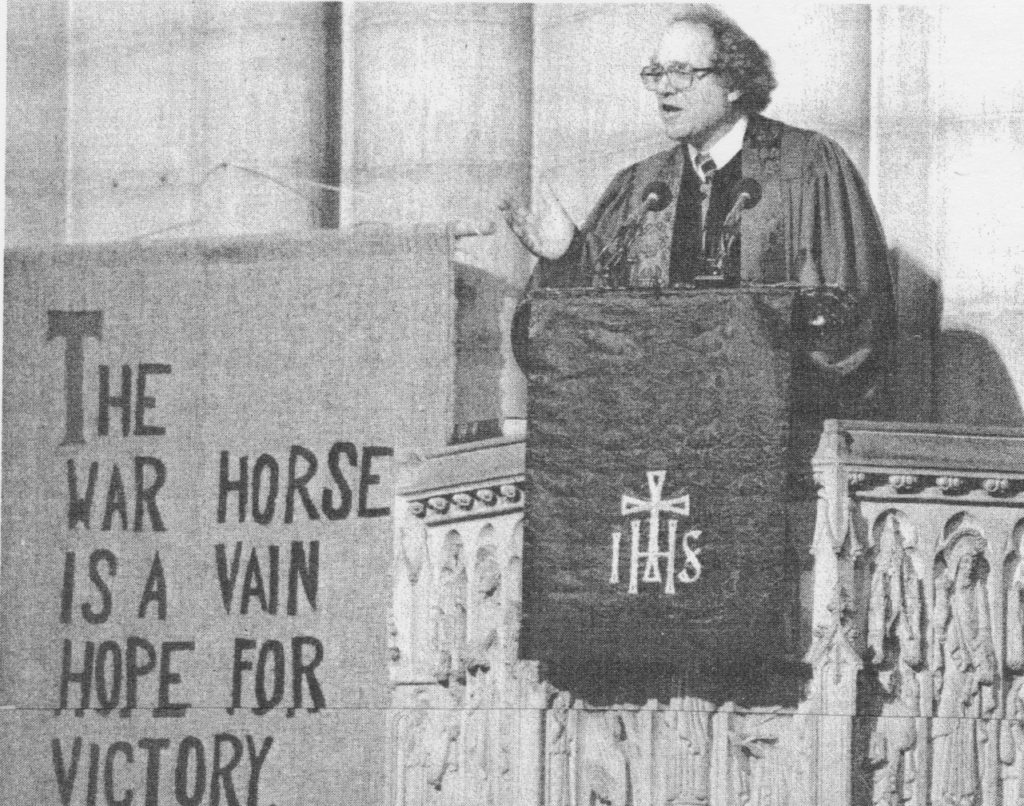
Kathy, the Advocacy Coordinator of the Southern Tier Office of Social Ministry located in Elmira, New York, and I partnered on a number of public witness activities during the years I was a church pastor there.  One day she called to say there was a Nuclear Disarmament Conference scheduled at Riverside Church in New York City and she wanted to know if I would like to go with her.  She didn’t have to ask twice.

Not long before her call I read Once to Every Man, the memoir of William Sloane Coffin who was the Senior Minister at Riverside.  It was one of those books I could not put down, and I read it in two days.  Subsequent to reading the memoir I got a copy of another Coffin book, Courage to Love, and eagerly soaked up every word of it, as well.  I wasn’t going to pass up a chance to spend two days with someone I found so inspiring.

It was about a four-hour drive from Elmira to New York, and I had arranged to stay overnight at the apartment of a member of Riverside, a Ms. Goossen, who volunteered to make accommodations available for a conference attendee.  Kathy, being from Queens, was booked in with relatives.  We found the street where Ms. Goossen lived, and Kathy dropped me off.

When I checked the address of her building I quickly saw there was no such street number, and as Kathy drove off, I wasn’t sure what to do.  It was dark as I picked up my suitcase and began walking, a bit aimlessly, trying to decide how I might find Ms. Goossen’s apartment.  This was shortly after the Bernard Goetz incident in which Goetz shot one or more young men who aggressively asked him for money on the New York subway.  As I walked along Broadway a man asked me for money, I said no, and he was very apologetic as he backed away.

One thought I had was to try and find Riverside Church and maybe spend the night there, but after walking a few blocks I went into a bar and found a phone booth.  Fortunately, there was a phone book chained to the booth, and even more fortunately, Ms. Goossen was listed.  I saw her address, called to say I was late arriving, and walked back to her street.  The address I originally was given had a couple of the digits transposed, causing the confusion.

The next morning I stood on the street until Kathy arrived to drive us to the church, and we went there without further trouble.

The first workshop I attended featured Rev. Coffin and Professor Seymour Melman of Columbia University speaking about the concept of Economic Conversion, which in essence meant finding a new purpose or product for a munitions factory rather than simply closing it down, thus saving the jobs of the employees.

Following the discussion, I went up to Rev. Coffin, introduced myself, and asked him to inscribe my copy of his book.  He opened the cover, saw where I had put my name, wrote “To” in front of it, then wrote, “God Bless!  Bill C”

Bill C was very visible throughout the whole conference, so I was pleased about that.  At a plenary session in the huge sanctuary Pete Seeger led some singing, and I remember Rev. Coffin introducing others who were present.  When he mentioned a young man there who was facing consequences for refusing to register with Select Service, he said, “We try to raise our children to be people of conscience, so it seems to me we should stand by them in their moments of conscience.” 

There were speakers and workshops on a variety of topics, not all directly related to nuclear disarmament, but equally inspiring nonetheless.  I recall one discussion about a call to boycott Campbell’s Soup because of the poor conditions experienced by produce pickers that supplied the company.  At one point I found a corner in the church and spent some time making notes for my sermon on the following Sunday.  I figured I never would preach at Riverside Church, but I could at least prepare a sermon there.

Following a final workshop I was supposed to meet Kathy in the main lobby outside the sanctuary so we could head for home.  It was a Saturday afternoon, there was a big wedding about to begin in the sanctuary, many people from the conference were milling about, and the elevator opened.  Among the people leaving the elevator there was a pigeon, walking out with everyone as if he were just going about his business in a normal way. None of his fellow passengers seemed to notice or care as he disappeared into the crowd.

Needless to say, after spending time at the conference, being with Rev. Coffin and so many others dedicated to matters of peace and social justice, I was renewed in my commitment to raise the issues that Kathy and I highlighted in our witness together in Elmira. 

Little did I know it would lead me to my further work with the Quakers, and to a few other even closer encounters with William Sloane Coffin, and with his successor Rev. Dr. James Forbes, along the way.


Tuesday, February 15, 2022

Kicking and Punching


One of the gigs we had in the Washington Metropolitan Police Boys Club Band was, I believe, a Boy Scout Jamboree at the D.C. Armory, most likely in 1968.  We probably played several John Phillip Sousa marches, and maybe the National Anthem.  While most of the details have faded from memory after all these years, what I recall for certain is that in the midst of everything else that occurred that evening there was a demonstration of Kung Fu by none other than Bruce Lee.

He wore a white suit as he demonstrated techniques and spoke about martial arts.  At the time, Bruce Lee was featured as the character Kato on the television show, The Green Hornet.  As a 13-year-old, I was more aware of him in that role than I was of his preeminence as a martial arts master.

Bruce Lee’s appearance at the event was sponsored by Jhoon Rhee, a prominent figure in introducing the Korean art of Tae Kwon Do to the United States, and who had several martial arts schools in the Washington, D.C. area.  Master Rhee actually showed up at one of our band rehearsals leading up to the night at the Armory.

At the time, I had little-to-no interest in martial arts and never once imagined that it would become a part of my life.  Like almost everyone else I had no real understanding of what the practice of the arts was about.  Much to my surprise, that all changed a little over twenty years later.  

Around 1990, our two sons, Gabe and Matt, said they wanted to learn Karate.  They, like many other children their ages (roughly 8 and 6 years old at the time) watched the Teenage Mutant Ninja Turtles on television and wanted to be like them.

After some discussion, we signed up the guys in the Fairfax County recreation program of Tae Kwon Do that featured weekly classes for children.  Mary and I sat with the other parents and watched the kids learn basic blocking, kicking, and punching techniques.  The guys enjoyed it, but I still did not think much of it. 

As the kids learned the techniques they occasionally were tested and given belt ranks as they advanced.  Starting as ‘No-belts” they first earned a white belt, then it was on to white stripe belt, and then gold belt.  At that point, the instructor recommended enrolling in an actual martial arts school if the kids intended to continue practicing.    I wasn’t enthralled with the prospect, but the guys were still enthused and wanted to keep going.

So, one evening I took them to the Mountain Kim Martial Arts School in Falls Church to investigate the possibility.  The instructor was Master Park, a solidly built young Korean man whose English, while not great, was better than my non-existent Korean language ability.  The school was one of several Mountain Kim schools, Mountain Kim being a Korean champion Tae Kwon Do master who oversaw the organization.  The Falls Church location was actually the basement with a downstairs entrance in back of a small strip mall shopping area.  There was indoor-outdoor carpet on the floor, mirrors along one wall, a few coat hooks just inside the entrance, a metal desk and chair for Master Park, and a couple of restrooms at the far end of the rectangular cinder block room.

As we discussed enrollment with Master Park, he looked at me and said, “You want to sign-up, too?”  Until that moment it never occurred to me to do so, but it made sense:  I would be there anyway as the guys took classes, and I was not engaged in much, if any, physical activity.  So, I signed up, put on a uniform and joined the class, taking my place in the back with the other “No-belts,” children and youth of various ages.   During the warm-ups, which actually were quite vigorous, Master Park kept an eye on me.  I guess he was worried I might keel over. 

We attended classes three evenings per week, and gradually advanced along the belt rank levels.  Tests were sometimes held at our school and sometimes were held elsewhere when all the Mountain Kim schools came together for tests.  There were tournaments a couple of times a year, and as I attended and observed it was apparent that those of us from the Falls Church school were in better shape and further advanced than most of the students from the other schools.  Master Park worked us hard, and it paid off.  Gabe and Matt won trophies and medals in their age categories at tournaments, as did others from the school.

After a couple of years, the three of us reached the rank of red belt, which was one step below black belt.  At that point, the recommendation was to add Fighting Class to our practice.  While sparring was a part of the training all along the belt-progression track, Fighting Class took it to another level.  So, now we were taking four classes per week, with Fighting Class on Saturday mornings.

I thought Master Park worked us hard before, but this was something else.  We put on full fighting gear even for the warm-ups, which were more intense than regular class warm-ups.  Then it was on to full-contact sparring, usually 8 or 10 two-minute rounds.  It was a workout.  I was about 38 years old.

Suddenly, something happened, and Master Park lost the lease to his school.  It closed and we had to transfer to another school.  We ended up at the McLean school, which was run by Mountain Kim’s brother, Myung Kim, called “Bruce Lee” Kim.  Right away, we saw again that Master Park worked us much harder than students were expected to work in other schools, but several of us from the Falls Church school were together again in McLean, and we took it to a higher level.  Some of the McLean students disappeared after a while.

Speaking of disappearing, we never heard from or saw Master Park again.  It’s still a mystery what happened to him, and none of the Mountain Kim people ever spoke of him or acted like they knew anything when asked.

While we attended weeknight classes at the McLean school, we went to the Vienna school for Fighting Class on Saturdays.  So, that all continued.

Mountain Kim always said that one out of ninety students who began classes at his schools made it to black belt.  The percentages vary among schools and programs, but it seems to be somewhere in that range universally.  I noticed a lot of turnover of students, and it seemed that green belt was a cut-off point for many people.  I’m not sure why, unless people felt they learned enough by that point for the art to be useful to them, but it was pretty common for folks to stop practicing at that level.  The remaining belts were blue, brown and red with the stripe levels in-between.  There was no red stripe, but red was the longest level at which people practiced, in preparation for the black belt test.

After about 26 or 27 months of intense practice, I was ready to test for black belt.  I was 39 years old.  The test lasted some three hours and included demonstrating proficiency at EVERYTHING learned up to that point:  kicking, punching, and blocking techniques; forms, or choreographed sparring patterns for every belt level; one-step sparring, which was a series of reactive moves to attacks, again, for every belt level; board-breaking:  five targets in a combination of punches and kicks for the test; Korean terminology for the techniques and for counting; and, of course, full-contact sparring.

At my test, I was the first one to do the sparring portion, and had to spar with 6 black belts consecutively with only a few seconds between, as one bowed out and the next one bowed in.  Then, I got back in line with the others being tested, and sparred with each of them, about a dozen in all.

Following the test by a couple of weeks was the Black Belt Ceremony where the belts and certificates were presented by Mountain Kim.  In his speech he reminded us of our responsibilities as leaders among the other students, and told us once again, as we were told at the very beginning of our practice as No-belts, to only use Tae Kwon Do techniques in the most extreme circumstances.  It would be better to run away than to fight, he reminded us, and even issued ID cards that we could show to someone who threatened us, letting them know we were black belts.

Part of the responsibilities of black belts was to not only set an example for lower belt students, but also to become instructors.  So, I began teaching classes at the McLean school, holding and grading tests there and at the larger Mountain Kim group tests, and refereeing at tournaments.  I also competed in three tournaments, reaching the final round each time, and winning Grand Champion once, at age 40.

When I finally gave up Tae Kwon Do practice, I was teaching seven classes per week, including one at a local elementary school.  It was, of course, in addition to my real job.

After a few years we moved to Florida, and there Mary and I took up the practice of Tai Chi, which included other Chinese martial arts forms.  After a few years I was teaching classes again, this time just once per week.  All told, I actively practiced martial arts for about 16 years.

So, even though I watched Bruce Lee demonstrate martial arts all those years ago and did not take it seriously, I ended up giving a good portion of my middle years to the practice.  I wish I had begun earlier, and treasure the time spent engaged in a way of life that provided relief from great stress I experienced in my working life, gave me an opportunity to share something meaningful with my family, provided physical as well as mental benefits, introduced me to some nice people and a different culture, and was simply a lot of fun.

Just recently, our grandson Logan, at age 6, earned his gold belt in Tae Kwon Do, making him a third-generation martial artist in our family.


Monday, January 17, 2022

A Haiku

 Since we're snowed in, and our writers' group did not meet this month out of concern for the fast-spreading Omicron variant, today Mary issued a Haiku Challenge to the others in the group.  

Here's my somewhat silly entry:


Outside our window:

A bird with snow on his face.

I took a photo.


Thursday, January 6, 2022

William Penn -- CANCELED


     William Penn, Quaker writer, activist, and founder of Pennsylvania was also a slave owner, although he was an advocate for the humane treatment of slaves (if there were such a thing).  For 55 years his name was used on a Quaker program located on Capitol Hill in Washington, DC – William Penn House.

      In 1966, the Quaker lobbying organization known as the Friends Committee on National Legislation invited the heads of the Quaker United Nations Office in New York to establish William Penn House.  FCNL was overwhelmed by requests for education, training, and lobbying opportunities for those concerned about the Vietnam War and the Civil Rights Movement.

    Bob and Sally Cory moved to Washington, a rowhouse five blocks from the U.S. Capitol was acquired, seminars and training workshops began to occur, and housing was provided for the peace advocates who attended them and who otherwise arrived in Washington to take action on the issues.

     At first, the Corys lived on the premises of WPH, but eventually bought a small house down the street.  William Penn House was established “under the care” of Friends Meeting of Washington, the Quaker congregation in the city.  This was done to claim non-profit status.

     This month marks the opening of “Friends Place on Capitol Hill.”  The name of William Penn is stricken, because he owned slaves, $2 million worth of renovations to the 105 year-old building is due to be completed, and the FCNL Education Fund now owns and manages the property and program.  Friends Place, according to its newsletter, is “a new Quaker learning center and guesthouse that will promote civic engagement of young people.”

      Friends Place has a staff of three or four people doing the job I did for nine years as Executive Director of William Penn House from 1987 until 1996. 

      It seems as if things have gone full-circle, with FCNL now undertaking what it gave up trying to do all those years ago.  Times change, needs adjust, and ways of accomplishing goals are re-evaluated.

      During my tenure, William Penn simply was a name for the program, and I can think of only two days in those nine years when there was any focus on him.  Each time there was someone impersonating him.  Once was an anniversary open house, and once was a program intended to raise funds that was held at the Washington National Cathedral.  Otherwise, neither I nor anyone else gave much thought to the man.  We did not even have a portrait of him in the building, but FCNL decided he no longer was worthy of recognition. 

     When I first heard of all of this I was not quite sure what to think.  Those nine years were very difficult, and many memories came flooding back as I reflected on them.  I cannot remember or count all of the people who passed through the doors in those days, nor can I recall all of the programs I planned for visiting groups on topics such as the arms race, U.S.-Soviet relations, economic justice, hunger and poverty, racial justice, international human rights, and the environment.

       Some were, of course, more memorable than others.  I have shared the names of many of the prominent people I was able to engage as speakers for the seminar groups and workshops, and I feel blessed to have met them.  Others whose names are not widely known provided just as much meaningful interaction with those who came to WPH.  Many visits to meet with U.S. Senators and Members of Congress occurred, and I worked to provide opportunities for consideration of all sides of a given issue.     


       Guests coming to WPH for their own purposes ranged from the interesting and inspiring to the downright weird.  I actually threw out a group of Russians who were visiting through an exchange program with American University after members of the group violated house rules against drunkenness and other behaviors.

        I planned workcamp experiences for some of our groups, linking them with homeless shelters, soup kitchens, food pantries and the like during their time in Washington, We hosted groups such as the Congressional Hunger Fellows who called together activists from around the country for training prior to sending them out to work on the issues.  I arranged valuable learning opportunities for our interns who came for one-year terms, finding part-time positions for them with non-profits working on issues of interest to them.

         The main difficulty arose my second day on the job when a city construction inspector showed up and told me we were operating illegally since we did not have a Certificate of Occupancy as a “bed and breakfast” establishment.  Of course, WPH was no such thing, but we needed to comply with zoning rules and still get a Certificate of Occupancy.

          This began a two-and-a-half-year nightmare during which I had countless meetings with lawyers, architects, engineers, contractors, inspectors, zoning officials, and whoever else I had to deal with to get it done.  Of course, this also included raising money to pay for it all.  The WPH Board of Directors supported my efforts, but it was mostly on me to get it done. 

          Oh, did I mention I was hired as a nine-month Interim Executive Director following the blow-up of the WPH staff when my predecessor fired the House Manager, several of the interns quit, and then my predecessor was himself terminated?  I began with a staff of two young people who arrived two months prior to my being hired, and a janitor.

           While the city allowed us to continue operating as we tried to comply with the law, there came a point when we actually did have to close down the program for the better part of a year as we worked on the renovations.  It took a personal appeal by me to Mayor Marion Barry to get us over the hump when the rusty machinery of the D.C. Government ground to a halt at one point.  I still get stressed thinking about those days, but it finally got done, and we proudly displayed the Certificate of Occupancy for “Rooming/Boarding House.”  Of course, that had nothing to do with WPH, but the inches-thick book of official D.C. zoning classifications had no category describing our program.  They had to settle on something.  I didn’t care, just so I could be done with them.

            My next trick was to make WPH an actual 501 (c) (3) non-profit organization.  While the Corys were well-intentioned, wonderful people whom I admired and cherished, their original decisions regarding the legal status of WPH “under the care” of Friends Meeting of Washington did not fly.  We could not really claim that donations to the cause were tax-deductible, and we could not really avoid paying taxes on our income, although both of those situations were allowed to exist for over 20 years.

             So, it was back to lawyers, city and federal tax officials, and others germane to the cause, until finally I got the status officially changed to what it should have been all along.  Again, more stress just thinking about it.

             Meanwhile, staff members turned over regularly, seminar groups came and went, issues confronting the nation changed, programs were planned, other crises occurred (lightning strikes, staffer suicide, armed robbery, boiler blowout, roof leaks, you name it), and my nine-month interim period somehow turned into nine years. At the time of my departure I had the second-longest tenure as Executive Director, after founder Bob Cory.  I finally burned out, though, and simply could continue no longer.

             As I said, it was an extremely difficult job and time, and I was glad and relieved when I drove down East Capitol Street after my last day, having turned in my keys and heading home.  It was a great experience in many aspects, as I became familiar with the ways of the Religious Society of Friends and met some extraordinary people.  Obviously, I learned a lot, and accomplished some important goals for the organization, holding it together following a major upheaval and through some pretty lean times.

            There were physical and emotional tolls, though, as we constantly struggled with finances, and faced so many challenges while simply trying to do some good.  There were sleepless nights along the way, a lot of frustration, and a sense of always trying to keep WPH from falling apart.  Fortunately, it did not happen on my watch.

            Now, it is Friends Place on Capitol Hill, William Penn is scorned, and things are back to where they were before the Corys ever left New York.  After all that we went through so long ago, with many of the WPH board members, Bob and Sally Cory, and some of my staff now deceased, and all the interns scattered to the wind who knows where, I no longer have any association with the program.  I doubt few people care about or even remember those nine years of the story. 

             The work of Friends Place, though, is relevant and very important, and I wish them nothing but tremendous success, with the hope that their experience is much smoother than was mine.

Tuesday, December 21, 2021

Unsettled

 The following reflects a series of pastoral visits I made to an elderly minister who served for 25 years as the pastor of my first congregation AFTER he retired.  The last few weeks of his life were at home where family and friends looked after him.


The old man asked a question

As he lay there waiting to die.

Well over ninety years of life

Had passed before his eyes.


He preached thousands of sermons

And held the hands of the ill.

So many had prayed with him over that time

Seeking to know God’s will.


He seemed to realize I was present that day

But his mind clearly was elsewhere.

He wrestled with thoughts and deep concerns

With almost a sense of despair.


So many decades immersed in the Word

Yet confusion and wonder remained.

He spoke to me, to himself, to no one

His expression was deeply pained.


He asked several times, “What is grace?”

Was it something for me to define?

No, I simply waited in silence.

The answer he sought was not mine.


The old man asked a question

As he lay there waiting to die.

But after all those caring and helping years,

Had meaning and truth passed him by?

Friday, November 5, 2021

Now You Know!


Someone named Emerald Robinson recently went on television to inform her viewers about the deleterious effects of getting the Covid vaccine.  She also let the Twitterverse know of her insights:

Dear Christians:  The vaccines contain a bioluminescent marker called Luciferase so that you can be tracked.  Read the last book of the New Testament to see how this ends.       

 Twitter suspended her account, and her employers at Newsmax, which I take it is a right-wing “news” service, pulled her off the air, to its credit.

It’s disturbing that so many absurd rumors, conspiracy theories, and otherwise inane “thoughts” and “ideas” are promoted, not only among their adherents, but over the public airwaves to be consumed and often believed by people.  It appears that fear and a sense of powerlessness, or the supposed threat of powerlessness, are the ruling mindsets among a high percentage of the population.

One thing I never understood was why some people are so fascinated by the “last book of the New Testament,” AKA Revelation.

First of all, the images used by the writer are practically indecipherable by people of our time/place/culture/worldview.  Secondly, readers of Revelation have, through the ages, leapt to the conclusion that the “prophecies” were directly related to the times in which they lived.  Someone always pointed to people, events, trends, etc., no matter their own century, that “fulfilled” what they read in the text. And, as Emerald Robinson demonstrates, (two can play at this game!) it still happens. (One theory I heard, giving me pause, though, was that the 666 designation of the “Anti-Christ” could apply to a name with the corresponding number of letters:  Ronald Wilson Reagan.  Yeah, I voted for Carter and Mondale.)  Thirdly, I am of the opinion that Revelation was an attempt by John to provide hope and comfort to First Century Christians who suffered under the thumb of Rome.  I could, believe it or not, be wrong about that, but I think it makes a lot of sense.

From Rudy Giuliani saying “It’s not my job” to verify the “facts” of his election fraud claim; to the My Pillow guy holding conferences to “prove” that Biden was fraudulently installed as president, and that Trump would be “re-instated” (supposedly last August); to Rand Paul blaming Dr. Fauci for the pandemic, we are bombarded with imaginative and fear-producing nonsense.

A new level of absurdity (not sure if it’s a high or low level) was attained recently as hundreds of people gathered at Dealey Plaza in Dallas, the site of the JFK assassination, because they were convinced JFK, Jr., who died in a plane crash in 1999, would show up.  Some apparently thought his father would accompany him.

It’s a convoluted notion, but some claim that Jr. is Q of QAnon, and that he has been hiding out, or assuming another identity (several are suggested) for the last couple of decades, only to finally be revealed as the vice president for Trump who “is lying in wait to destroy a secret cabal of blood-drinking, child-sex-trafficking members of the liberal elite,” according to a Rolling Stone online article by E.J. Dickson and Steven Monacelli.  It also seems many of the devotees of this “mindset” believe that every election and law passed since the late 1800’s will be invalidated, Trump will be the true 19th President of the United States, and John John will be V.P. until Trump vacates the office to become the “King of Kings.”  This again, is a Revelation reference, from Chapter 17.

Hundreds, if not thousands, of people find all of this to be true.  Unfortunately for them, JFK, Jr. rudely failed to show in Dallas even though throngs stood in the rain waiting for him.

We’ve come a long way from the days of people denying the Holocaust, asserting that the moon landing in 1969 was nothing but an event staged on a Hollywood back lot, and insisting (and hoping!) that Elvis, sideburns and all, still lives.

Personally, the value in Revelation for me comes from Chapter 21.  After all the dragons, beasts, plagues, riders on horses, and other scary stuff John paraphrases the Old Testament prophet Isaiah (near the end of his “revelation” in Chapter 65):

Then I saw a new heaven and a new earth; for the first heaven and the first earth had passed away, and the sea was no more. And I saw the holy city, the new Jerusalem, coming down out of heaven from God, prepared as a bride adorned for her husband. And I heard a loud voice from the throne saying,

“See, the home of God is among mortals.

He will dwell with them as their God;

they will be his peoples,

and God himself will be with them;

he will wipe every tear from their eyes.

Death will be no more;

mourning and crying and pain will be no more,

for the first things have passed away.”

And the one who was seated on the throne said, “See, I am making all things new.” (NRSV)


One day, long ago and far away, I was in the library at my seminary lamenting some forgotten ill.  I concluded my diatribe with a sigh and the observation, “It’s a crazy world.”

My friend Bill Harris, with whom I was speaking, said without hesitation, “I’m looking for a better one.”                      

Wednesday, October 13, 2021

"Is That A Caterpillar Under Your Nose?"


It was the summer of 1972, a few weeks before I left for college with the hope of becoming an East Carolina University Pirate.  “Earl’s not gonna like that mustache.”  Earl was Earl Smith, head baseball coach at ECU.   A former Pirate was sharing acquired wisdom. The mustache was mine. 

I was accustomed to archaic hair rules for baseball players.  Untamed tresses and facial fuzz, be it sideburns, mustaches, or beards, were deemed by all my previous coaches as inappropriate and downright un-American.

Cursing was allowed.  Tobacco use was allowed.  Alcohol consumption was allowed.  Caveman attitudes were allowed. 

Mustaches?  Not allowed! 

Things are different now.  Facial hair abounds in sports, professional and otherwise.

There also are some widely-observed events that actually celebrate such adornments.  “Movember” is one.  Men everywhere are urged during the month of November – officially Mustache Month -- to grow mustaches in order to engage others in conversations about men’s health issues, specifically testicular and prostate cancer.  The goal is to raise money for research into treatments and cures. 

The Air Force offers similar encouragement to airmen during Mustache March, a month-long honoring of Vietnam-era flying ace Robin Olds, lionized for flouting military grooming rules. Olds fought battles wearing a handlebar mustache – complete with wax -- until he finally received a direct order to lose it.  Allowing a little room for command-sanctioned protest and defiance is good for morale.

An official Mustache Day is less-established.  Dates in February and March are touted, but no consensus exists.

My first mustache sprouted early in my senior year of high school. Yes, it was the ‘70s, but I wasn’t aspiring to hippie status.  I wanted to be like Reggie Jackson, the home run-slugging outfielder of the Oakland A’s who neglected to shave his upper lip as the 1971 major league season wound down.  Many people, including me, noticed Reggie’s recalcitrance.

I endured clever responses as nature took its course.  “What’s this?” people asked, as they pointed to their own lips.  “Did you forget to wash your face?”  “Is that a caterpillar under your nose?”  It seemed my high school baseball coach thought I was a Communist.  He started calling me “Fidel.”  Although I shaved for the season, I rejoined my comrades when it was over, sans olive drab and black boots.

Men with mustaches sometimes are described as looking like a “’70s porn star.”  How do so many people know about that? 

Over the summer after the last time I chopped off my upper lip growth (to satisfy Earl Smith), I played baseball in a local league back home.  My mustache was bushy and my hair lopped over my ears.  Oddly enough, I still could play the game. Some of the flashing wits in opposing dugouts called me “Grandpa.”  I was 18 years old.  They were jealous. 

When I attended seminary a few years later I found a more welcoming environment for my outlandish appearance. On the first day of a class simply titled, “Isaiah,” as we took seats around a square table, our distinguished professor suggested we each introduce ourselves.  “And we’ll begin with the gentleman with the beautiful black mustache.”  He emphasized the second syllable, and he meant me. 

Beautiful black gradually gave way to salt-and-pepper, which now blend into a fairly consistent grey.  My upper lip now celebrates 49 years of liberation from razor blades. 

These days it seems when a mustache is cultivated it is met not with challenge and derision, but more likely apathy.  Years have piled up since anyone found it necessary to mock or chastise me for my bristly friend.  In fact, on the rare occasion anyone comments about my mustache, it’s an expression of admiration. 

I have achieved a state of whiskered peace and contentment.

But what’s with this trend of a three-day stubble?  Did those guys forget to wash their faces?  Do they need to borrow my razor?

What has happened to our standards??